ABOUT THE AUTHORS 10
1 INTRODUCTION 23
1.1 USES OF COMPUTER NETWORKS, 25
1.1.1 Business Applications, 25
1.1.2 Home Applications, 28
1.1.3 Mobile Users, 32
1.1.4 Social Issues, 36
1.2 NETWORK HARDWARE, 39
1.2.1 Personal Area Networks, 40
1.2.2 Local Area Networks, 41
1.2.3 Metropolitan Area Networks, 45
1.2.4 Wide Area Networks, 45
1.2.5 Internetworks, 50
1.3 NETWORK SOFTWARE, 51
1.3.1 Protocol Hierarchies, 51
1.3.2 Design Issues for the Layers, 55
1.3.3 Connection-Oriented Versus Connectionless Service, 57
1.3.4 Service Primitives, 60
1.3.5 The Relationship of Services to Protocols, 62
1.4 REFERENCE MODELS, 63
1.4.1 The OSI Reference Model, 63
1.4.2 The TCP/IP Reference Model, 67
1.4.3 The Model Used in This Book, 70
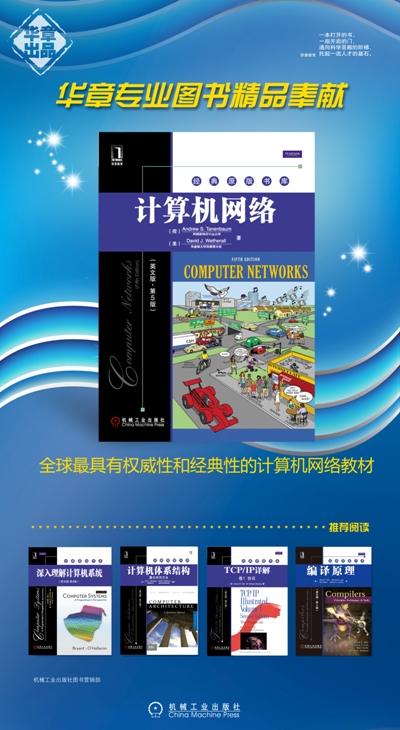
Computer Networks CONTENTS
Fifth Edition
PREFACE 6
12?CONTENTS
1.4.4 A Comparison of the OSI and TCP/IP Reference Models, 71
1.4.5 A Critique of the OSI Model and Protocols, 73
1.4.6 A Critique of the TCP/IP Reference Model, 75
1.5 EXAMPLE NETWORKS, 76
1.5.1 The Internet, 76
1.5.2 Third-Generation Mobile Phone Networks, 85
1.5.3 Wireless LANs: 802.11, 90
1.5.4 RFID and Sensor Networks, 93
1.6 NETWORK STANDARDIZATION, 95
1.6.1 Who’s Who in the Telecommunications World, 97
1.6.2 Who’s Who in the International Standards World, 98
1.6.3 Who’s Who in the Internet Standards World, 100
1.7 METRIC UNITS, 102
1.8 OUTLINE OF THE REST OF THE BOOK, 103
1.9 SUMMARY, 104
2 THE PHYSICAL LAYER 109
2.1 THE THEORETICAL BASIS FOR DATA COMMUNICATION, 110
2.1.1 Fourier Analysis, 110
2.1.2 Bandwidth-Limited Signals, 110
2.1.3 The Maximum Data Rate of a Channel, 114
2.2 GUIDED TRANSMISSION MEDIA, 115
2.2.1 Magnetic Media, 115
2.2.2 Twisted Pairs, 116
2.2.3 Coaxial Cable, 117
2.2.4 Power Lines, 118
2.2.5 Fiber Optics, 119
2.3 WIRELESS TRANSMISSION, 125
2.3.1 The Electromagnetic Spectrum, 125
2.3.2 Radio Transmission, 129
2.3.3 Microwave Transmission, 130
2.3.4 Infrared Transmission, 134
2.3.5 Light Transmission, 134
CONTENTS?13
2.4 COMMUNICATION SATELLITES, 136
2.4.1 Geostationary Satellites, 137
2.4.2 Medium-Earth Orbit Satellites, 141
2.4.3 Low-Earth Orbit Satellites, 141
2.4.4 Satellites Versus Fiber, 143
2.5 DIGITAL MODULATION AND MULTIPLEXING, 145
2.5.1 Baseband Transmission, 145
2.5.2 Passband Transmission, 150
2.5.3 Frequency Division Multiplexing, 152
2.5.4 Time Division Multiplexing, 155
2.5.5 Code Division Multiplexing, 155
2.6 THE PUBLIC SWITCHED TELEPHONE NETWORK, 158
2.6.1 Structure of the Telephone System, 159
2.6.2 The Politics of Telephones, 162
2.6.3 The Local Loop: Modems, ADSL, and Fiber, 164
2.6.4 Trunks and Multiplexing, 172
2.6.5 Switching, 181
2.7 THE MOBILE TELEPHONE SYSTEM, 184
2.7.1 First-Generation (1G) Mobile Phones: Analog Voice, 186
2.7.2 Second-Generation (2G) Mobile Phones: Digital Voice, 190
2.7.3 Third-Generation (3G) Mobile Phones: Digital Voice and Data, 194
2.8 CABLE TELEVISION, 199
2.8.1 Community Antenna Television, 199
2.8.2 Internet over Cable, 200
2.8.3 Spectrum Allocation, 202
2.8.4 Cable Modems, 203
2.8.5 ADSL Versus Cable, 205
2.9 SUMMARY, 206
3 THE DATA LINK LAYER 213
3.1 DATA LINK LAYER DESIGN ISSUES, 214
3.1.1 Services Provided to the Network Layer, 214
3.1.2 Framing, 217
3.1.3 Error Control, 220
3.1.4 Flow Control, 221
14?CONTENTS
3.2 ERROR DETECTION AND CORRECTION, 222
3.2.1 Error-Correcting Codes, 224
3.2.2 Error-Detecting Codes, 229
3.3 ELEMENTARY DATA LINK PROTOCOLS, 235
3.3.1 A Utopian Simplex Protocol, 240
3.3.2 A Simplex Stop-and-Wait Protocol for an Error-Free ... |